
The Renton City Council is scheduled to convene for a decisive vote on Monday regarding a proposed municipal ordinance that would prohibit camping on public property across the city. If approved, the measure would mark a major shift in how local authorities manage public spaces and respond to unsanctioned encampments situated throughout municipal grounds.
This upcoming legislative decision positions Renton to follow a broader regional trend taking shape across Washington State. Several nearby municipalities, including Lakewood, Tukwila, and Burien, have previously enacted comparable prohibitions in response to the growing challenges associated with unsanctioned encampments on public land.
The push by local governments across the region to adopt stricter camping regulations gained significant legal momentum following a landmark ruling by the U.S. Supreme Court. The nation's highest court determined that municipal public camping bans do not violate the Eighth Amendment of the U.S. Constitution, clarifying that enforcing such restrictions does not constitute cruel and unusual punishment against people without shelter.
Under the specific provisions outlined in Renton's draft ordinance, individuals would be strictly barred from erecting temporary shelters, including tents and tarps, anywhere on city-owned property. The language of the policy broadly applies these restrictions to a wide range of public areas, ensuring that parking lots, municipal parks, and public trails remain free of unauthorized structures.
Beyond prohibiting the setup of tents and tarps, the proposed legislation outlines several additional restrictions aimed at curbing the footprint of unsanctioned living on public land. The measure makes it unlawful to ignite or maintain fires, store personal property, or stash shopping carts within designated municipal areas, effectively barring the key physical items typically associated with outdoor encampments.
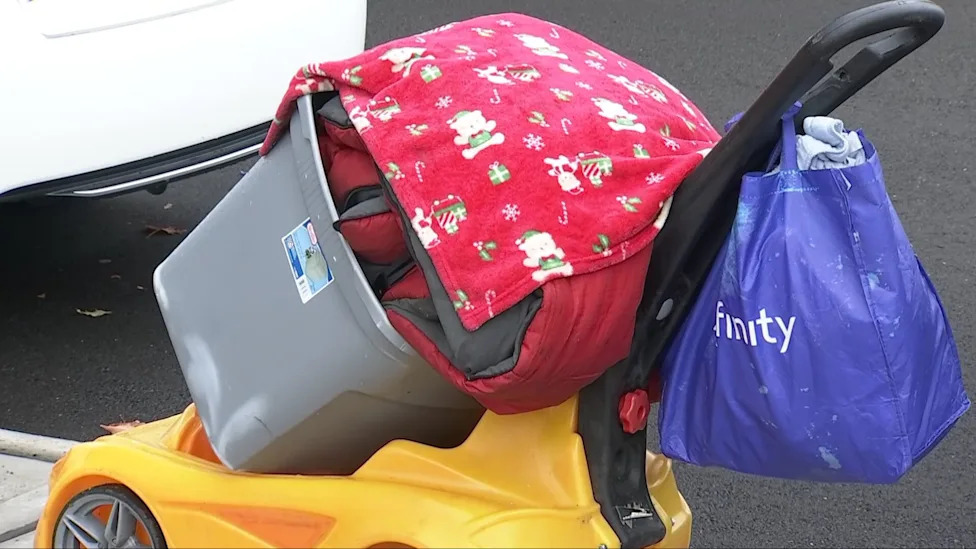
The proposed restrictions arrive as unhoused community members continue to navigate significant hardships in securing shelter. In downtown Renton, individuals such as Nicole reflect the everyday realities of life on the streets. Nicole, who was recently seen navigating the city's sidewalks while transporting her remaining belongings piled atop a child's push car, spoke candidly about her personal vulnerability.
Having experienced homelessness for roughly three to four years, Nicole explained that she has lost everything during her time without stable housing. Like many individuals in similar circumstances, she has routinely relied on open parking lots as places to rest and sleep at night—locations that would be entirely off-limits under the city council's proposed restrictions.
While local leaders frequently point to emergency shelter networks as the intended alternative to street encampments, some unhoused residents harbor deep reservations about entering these facilities. Nicole stated plainly that she refuses to stay in shelters, explaining that she finds them untrustworthy, unhealthy, and unsuitable, ultimately preferring to remain on the open streets rather than reside inside a shelter environment.
This strong reluctance toward institutional shelter options highlights the central dilemma surrounding the proposed camping ban. For unhoused residents who distrust available facilities, the municipal prohibition against pitching tents, utilizing tarps, and resting in parking lots leaves remarkably few lawful options for where they and their belongings can legally remain within city boundaries.
Supporters of the ordinance, however, argue that clear regulations are essential to address the wider community impacts of public encampments. Max Komar, representing Battlefield Addiction—a non-profit organization dedicated to assisting individuals struggling with substance abuse, including those residing in homeless camps—advocates for a framework that combines compassion with civic accountability.
According to Komar, effective municipal policies must carefully balance the needs of neighborhood residents with those of individuals facing homelessness and addiction. He emphasized that local families have a right to feel safe within their neighborhoods, maintaining that reasonable public policies should actively safeguard communities from open-air drug use and hazardous, unsanctioned camping.
At the same time, Komar stressed the necessity of pairing community protection with meaningful pathways toward recovery. Renton's proposed anti-camping measure reflects this principle by incorporating language that explicitly requires outreach workers and service providers to offer social services and support resources to unhoused individuals encountered on public property.
Alongside outreach requirements, the legislation incorporates formal enforcement procedures for non-compliance. The proposed ordinance authorizes the establishment of specific trespassing zones, providing local authorities with the legal structure needed to intervene when individuals refuse to vacate prohibited public spaces.
For individuals who repeatedly violate the camping ban and ignore trespassing boundaries, the proposed law outlines formal legal consequences. Repeat offenders could be charged with a misdemeanor offense, exposing violators to potential penalties that include up to 90 days of incarceration in jail as well as fines reaching up to $1,000.
As the Renton City Council prepares to cast its vote, community attention remains fixed on how the measure will be implemented. If passed, the ordinance will represent a major turning point for the municipality, redefining how local law enforcement, service organizations, and unhoused residents interact throughout Renton's public spaces.





(0)