
State lawmakers in Trenton are considering sweeping legislation that would fundamentally alter how automated license plate recognition technology is deployed across New Jersey. Introduced by Assemblyman David Bailey Jr., Democrat of Salem, Assembly Bill A5483 seeks to implement some of the nation's tightest restrictions on artificial intelligence-powered surveillance cameras, mandating that government and law enforcement entities purge captured license plate data after just 48 hours.
The measure focuses specifically on automated license plate readers, commonly referred to as ALPRs, which are widely recognized by the brand name Flock Safety. These specialized camera systems automatically photograph passing traffic and utilize artificial intelligence to record vehicle license plates alongside identifying features such as make, model, and color. The gathered information is then organized into searchable databases accessible to investigators.
According to statements released by Assembly Democrats, the bill aims to address mounting privacy issues stemming from the pervasive reach of automated tracking networks. Assemblyman Bailey emphasized that the unchecked accumulation of vehicular travel data threatens the privacy rights of everyday New Jersey residents, arguing that ordinary motorists should not have their daily routines monitored, cataloged, and archived without strict expiration limits.
While acknowledging that automated scanners can play a role in criminal investigations, Bailey stressed that the technology must be subject to rigorous oversight rather than open-ended surveillance. The sponsor noted that while police forces can utilize the tools for public safety, current statewide deployment lacks necessary safeguards to prevent mass monitoring of innocent people.
Under the provisions of the proposed bill, private individuals and commercial entities would face an outright prohibition on operating license plate scanning systems, with exceptions made only for vendors responsible for manufacturing and installing the units. Private owners would be mandated to dismantle existing camera setups and destroy all accumulated data records, with the New Jersey Attorney General empowered to file lawsuits to enforce compliance.
Governmental and municipal bodies would also see their use of ALPR technology drastically curtailed. Under the bill's framework, non-law-enforcement state agencies would only be permitted to operate camera systems for narrow administrative functions, such as overseeing public parking facilities, enforcing electronic toll collection, and maintaining access controls at secure installations.
State Police and municipal law enforcement agencies would retain broader permissions, but their operations would be tightly bound to designated "be on the lookout," or BOLO, notifications. Officers could deploy scanning networks to locate stolen vehicles, identify missing individuals, and track vehicles associated with serious crimes, uninsured motorists, lapsed state inspections, or registration infractions.
To prevent discriminatory surveillance, the legislation explicitly prohibits police departments from positioning plate readers to monitor neighborhoods or populations based on protected characteristics. Agencies would be barred from selecting camera locations based on race, religious affiliation, national origin, or disability status.
The most transformative component of the legislation targets New Jersey's data retention framework. Under current state policy, law enforcement agencies are permitted to store ALPR scan records for three years, representing one of the longest storage periods in the United States. In contrast, many states cap data retention at 30 days or less, and certain jurisdictions require non-matching vehicle scans to be expunged within five minutes.
Assembly Bill A5483 would overhaul New Jersey's policy by requiring automatic and permanent deletion of collected records within two days. The only scans exempted from the two-day purge rule would be those directly tied to active criminal investigations, authorized by court orders, or flagged for specific offenses such as stolen status, registration violations, or major felony investigations.
The bill also imposes rigorous procedural hurdles for sharing data outside state lines. State Police and local departments would no longer be permitted to share license plate information with federal authorities or out-of-state law enforcement agencies without obtaining a warrant approved by the Attorney General. Current practice permits select neighboring state agencies and New Jersey-based federal partners direct search access.
Commercial vendors providing ALPR infrastructure would be strictly forbidden from selling, monetizing, or sharing data captured within the state. Additionally, participating law enforcement agencies would be subjected to mandatory annual audits and public reporting rules to maintain transparency regarding how frequently databases are queried.
The legislative push arrives amid rapid technological expansion across the state. Official state audit records show that 523 out of roughly 530 police departments in New Jersey currently employ automated license plate readers. Furthermore, records from Flock Safety reveal that at least 82 local agencies across all 21 counties have direct contracts with the private surveillance provider.
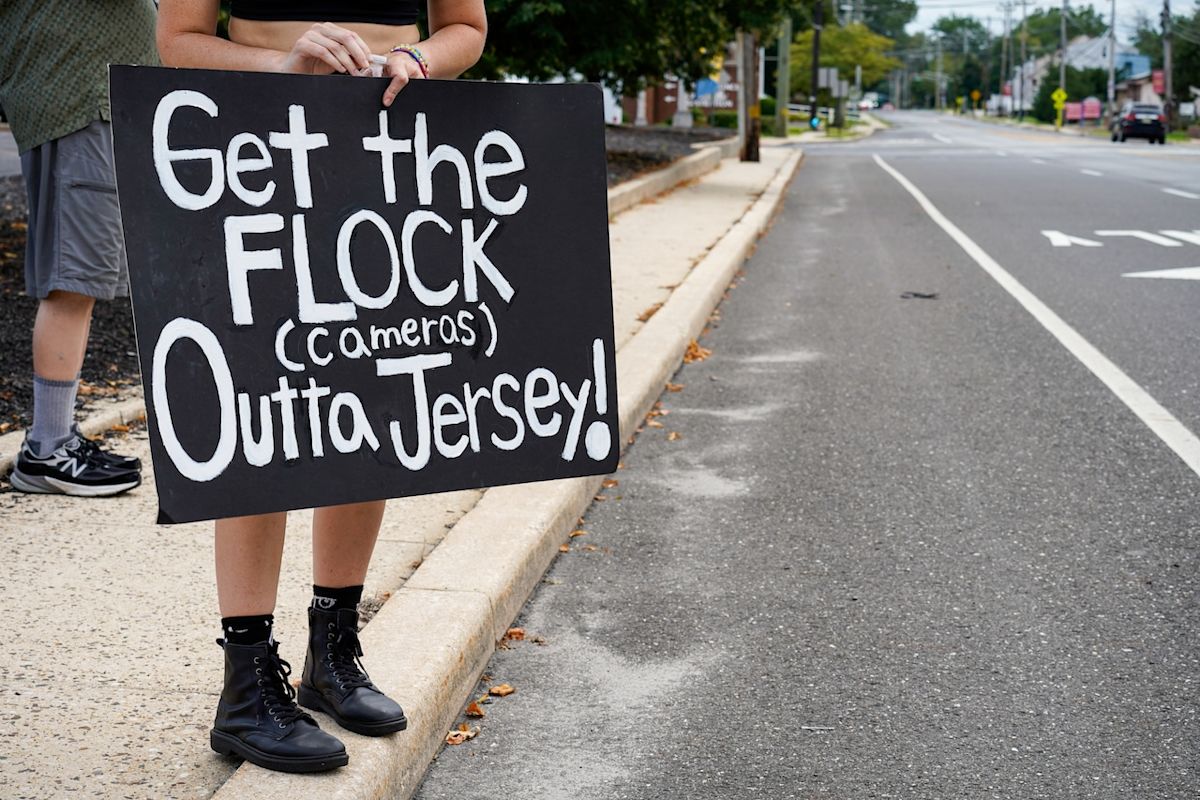
The proliferation of these cameras has sparked growing public opposition and grassroots demonstrations. In August, more than two dozen community members organized by the group DeFlock South Jersey gathered outside a Berlin Township Home Depot to protest automated monitoring. Activists, accompanied by a demonstrator in a mascot suit named "Flocky," called for the dismantling of local cameras until stronger privacy protections are codified into law.
Community pushback has also surfaced in local municipal meetings, including in Franklin Township, where an overflowing crowd voiced concerns over mass surveillance and presented a petition containing more than 800 signatures demanding an end to tracking practices that residents characterized as invasive stalking.
Assemblyman Bailey's proposal is part of a wider legislative discussion taking shape in the State House. State Senator Benjie Wimberly, Democrat of Passaic, has previously proposed a stalled measure to lower the data retention cap to two years while introducing criminal penalties for surveillance misuse. Meanwhile, State Senator Linda Greenstein, Democrat of Middlesex, has introduced legislation to prevent plate data from being shared in out-of-state reproductive healthcare investigations, and State Senator Michael Testa, Republican of Cumberland, announced plans over the summer to present his own regulatory safeguards.


(0)