
A large-scale maritime search and rescue operation was launched in Indonesia after a passenger ferry capsized amid severe weather conditions in the Java Sea on Sunday. The disaster has left approximately 130 passengers and crew members unaccounted for, prompting emergency agencies to mobilize extensive air and sea assets across the vast waterway.
According to emergency response authorities, at least 107 people have been successfully pulled from the waters alive as rescue teams comb through the area surrounding the vessel's last confirmed coordinates. Tragically, search crews have also recovered the bodies of six passengers who did not survive the overturning of the vessel.
The stricken passenger vessel, identified as the Virgo Transport 8, was undertaking a routine inter-island voyage carrying more than 240 people. It had departed from the major port city of Surabaya in East Java and was en route to Banjarmasin, located in the South Kalimantan province on the island of Borneo, when it encountered perilous conditions.
Official ship documentation indicated that there were 243 individuals registered aboard the vessel at the time of departure, comprising 213 passengers and 30 crew members. In addition to the human travelers, the ferry was transporting cargo that included 89 motor vehicles stored on its vehicle decks.
Discrepancies in passenger documentation remain a critical factor in understanding the true scale of the accident. Maritime authorities noted that it is relatively common in Indonesia for the actual number of individuals aboard inter-island transit vessels to differ from the figures recorded on official passenger manifests.
The sequence of events leading up to the disaster began in the early morning hours of Sunday. Before communication was severed, the ship's captain managed to transmit a distress call alerting maritime authorities that the vessel was listing dangerously after being battered by rough seas and waves reaching heights of up to 10 feet.
I Putu Sudayana, head of the Banjarmasin Search and Rescue Office, stated that contact with the Virgo Transport 8 was officially lost at approximately 2:00 a.m. local time on Sunday. The regional rescue agency received formal reports regarding the lost contact roughly two hours after the vessel's communications ceased, immediately triggering emergency procedures.
Preliminary navigation data established that the vessel's final reported position was located in the open waters of the Java Sea, roughly 92 miles from its intended destination port of Banjarmasin. Subsequent information confirmed that the vessel had completely overturned in the churning seas.
Transportation Minister Dudy Purwagandhi provided critical operational details to the press on Sunday, revealing that aerial surveillance teams had located the overturned ferry. The minister noted that the vessel was floating upside down in the water and had not yet sunk to the ocean floor, allowing rescue teams to concentrate their immediate recovery efforts directly around the buoyant hull.
To locate additional survivors, search coordinators significantly expanded their operational footprint by Sunday afternoon. Authorities deployed a specialized fleet of eight rescue vessels, including four Indonesian navy ships, supported by two helicopters conducting low-altitude sweeps across the sea surface.
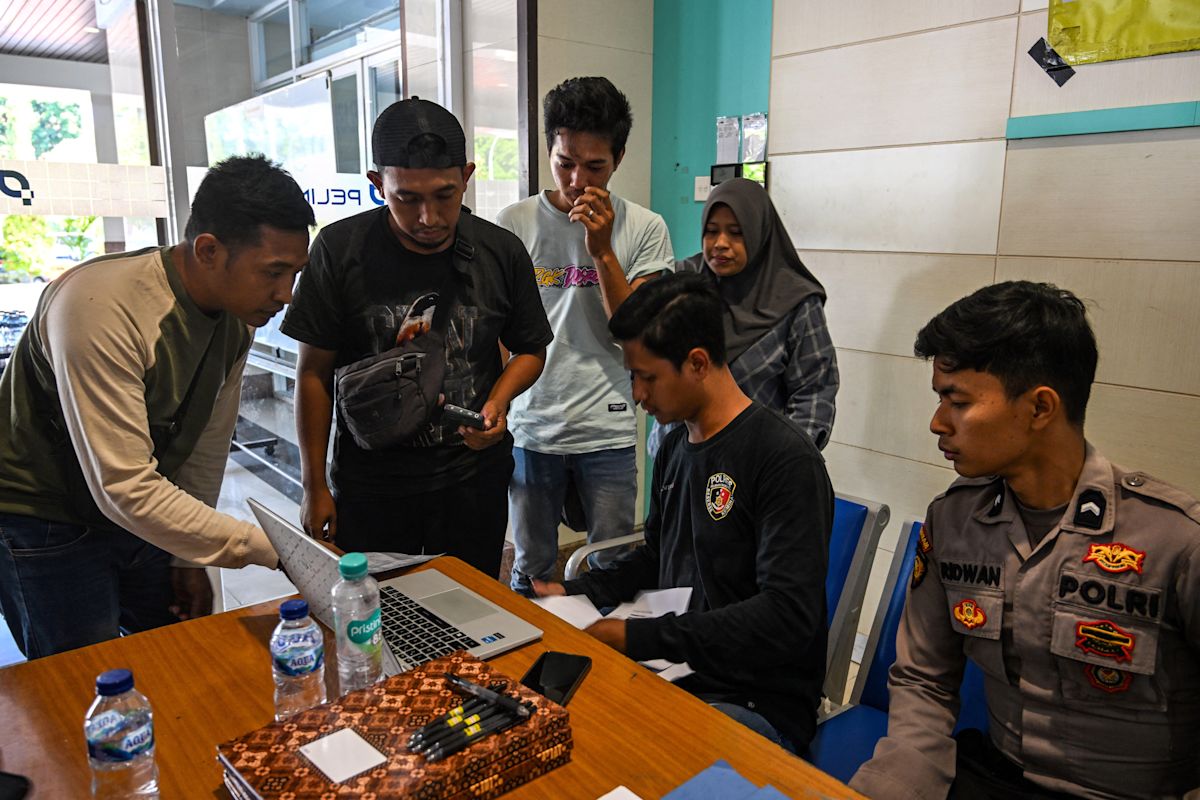
Back on land, scenes of profound grief and anxious anticipation unfolded at the Trisakti Bandarmasih Port in Banjarmasin. Hundreds of worried relatives converged on the designated emergency command post, desperate for any verified information regarding family members who had boarded the Surabaya-to-Banjarmasin route.
Family members spent hours closely examining updated passenger logs and rescue survivor lists as emergency personnel continued their work offshore. Local police officers were stationed at the port facility to gather passenger details from distraught family members, including Ela Nur Atika, whose husband was aboard the stricken ferry.
Amid the distress, some families received welcome news regarding their loved ones. A relative named Bunga recounted the emotional roller-coaster of learning about the incident, explaining the initial shock of seeing her uncle's name on the passenger list followed by immense relief once emergency officials confirmed that he was among the 107 survivors rescued from the sea.
The incident highlights the logistical realities of Indonesia, a vast archipelago nation comprising more than 17,000 distinct islands where ferry transport serves as a vital and indispensable link between communities and provincial economies.
Despite their necessity, maritime journeys across the Indonesian archipelago have frequently been marred by fatal accidents. Industry observers and critics often point to weak enforcement of regulatory standards, challenging weather patterns, and maritime safety compliance issues as recurring factors in such oceanic disasters.





(0)