
Throughout modern history, September 13 has repeatedly served as a backdrop for transformative moments in warfare, governance, international relations, and culture. From the creation of a national anthem during a nineteenth-century naval bombardment to historic peace accords signed on the White House lawn, the date encompasses centuries of human triumph and crisis.
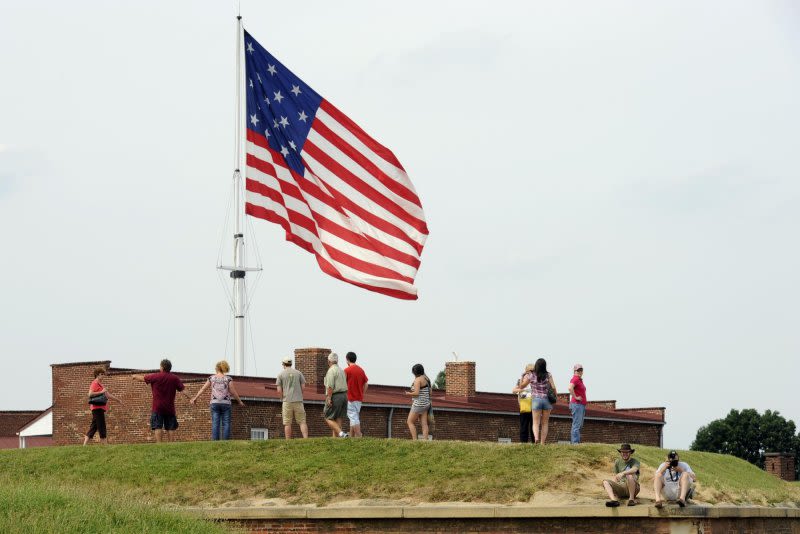
In 1814, amid the height of the War of 1812, British forces launched a relentless assault on Fort McHenry in Baltimore, Maryland. It was during this intense bombardment that Francis Scott Key penned the verses that would become "The Star-Spangled Banner." Watching the resilience of the American garrison under fire inspired the lyrics that were later adopted as the official national anthem of the United States.
The events at Fort McHenry represented a defining turning point in early American military history. The survival of the fortification through the night of British shelling demonstrated the nation's resolve, and Key’s written account captured the emotional weight of witnessing the American flag still waving above the ramparts at dawn.
More than a century later, on September 13, 1940, the destruction of war struck the British monarchy when a German air raid targeted London during the Blitz. A bomb destroyed the royal chapel inside Buckingham Palace, marking one of nine separate instances in which the royal residence came under direct fire during the course of World War II.
The bombing underscored the indiscriminate reach of the aerial assault on Britain. Ten days after the strike on the royal chapel, King George VI addressed the public, delivering a resolute speech in which he condemned the "wickedness against which we fight" and reinforced national solidarity in the face of ongoing German aggression.
American political history reached a landmark milestone on this date in 1948, when Margaret Chase Smith secured election to the United States Senate. Representing the state of Maine as a Republican, Smith achieved historic recognition by becoming the very first woman to serve in both chambers of the U.S. Congress, having previously served in the House of Representatives.
Smith’s victory stood as a significant breakthrough in twentieth-century legislative history, opening new paths for female leadership in federal government. Her ascension to the Senate demonstrated growing shifts in the American political landscape during the post-war era.
Decades later, tragedy struck within the American correctional system on September 13, 1971. New York state authorities ordered armed forces to storm the Attica Correctional Facility in order to regain control following a major inmate uprising. The violent operation resulted in the deaths of 43 people, cementing the Attica incident as one of the deadliest prison confrontations in the nation's history.
International diplomacy took center stage on this date in 1993 during a historic gathering at the White House. Israeli Prime Minister Yitzhak Rabin and Palestine Liberation Organization Chairman Yasser Arafat signed a declaration of principles aimed at establishing a framework for Palestinian self-rule.
The 1993 declaration stood as a major diplomatic initiative aimed at altering the trajectory of the Middle East conflict. The signing ceremony, accompanied by a symbolic public handshake between long-time adversaries, established initial pathways toward peace and administrative autonomy in contested regions.
The entertainment world suffered a profound loss on September 13, 1996, with the death of rapper and cultural figure Tupac Shakur. Shakur succumbed to his injuries in Los Angeles six days after being targeted in an ambush shooting that took place on September 7, bringing a sudden end to his influential music career.
In 2001, just two days after the September 11 terrorist attacks, the United States aviation sector took its first steps toward recovery. Commercial air carriers received permission to resume flights on September 13, while airports nationwide implemented stringent new security protocols to address vulnerabilities exposed by the disaster in New York City and Washington, D.C.
Human rights advocacy marked a breakthrough on September 13, 2007, when the United Nations General Assembly officially adopted the Declaration on the Rights of Indigenous Peoples. Although the United States cast a dissenting vote, the passage of the non-binding document was widely recognized as a watershed development in international law.
The 2007 UN declaration established international standards protecting the collective and individual rights of Indigenous populations. The comprehensive document outlined specific protections concerning cultural identity, preservation of language, equitable employment, access to healthcare, and educational opportunity.
Natural disaster struck the Gulf Coast on this day in 2008 when Hurricane Ike slammed into Galveston and Houston, Texas. Packing sustained winds of 110 miles per hour and torrential rainfall, the powerful storm triggered mass evacuations of approximately 1 million residents and knocked out electrical power to millions across the region.
The destructive footprint of Hurricane Ike resulted in severe casualties, ultimately claiming more than 100 lives across the United States and roughly 75 fatalities in Haiti. Viewed in retrospect, September 13 remains a calendar date defined by extraordinary resilience, sweeping geopolitical developments, and profound historical transitions.







(0)