
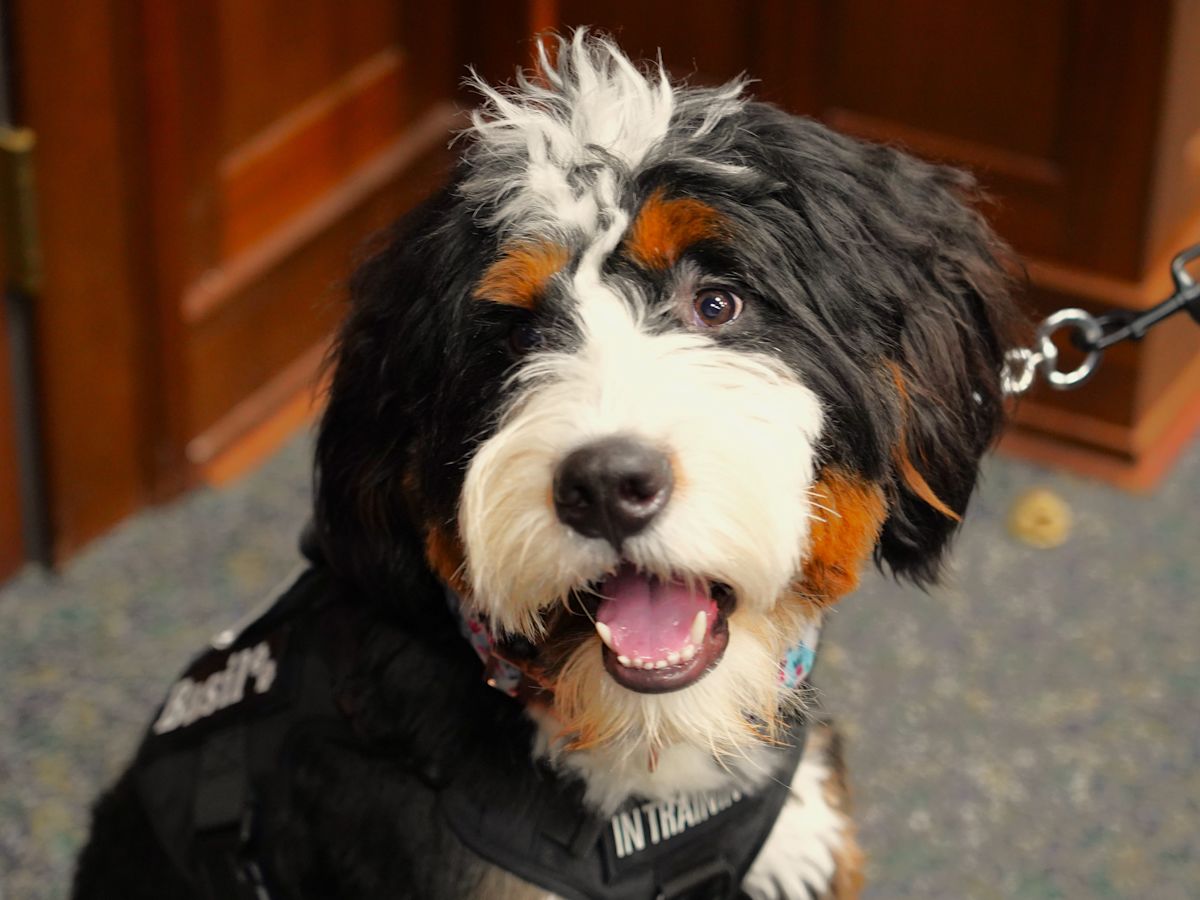
Receiving a summons for jury duty often elicits an involuntary sigh from busy citizens, but those assigned to grand jury service in Hamilton County encounter an unexpected source of comfort. Walking the halls of the county prosecutor's office is Basil, a dedicated therapy dog whose presence helps ease the emotional burden of the legal process.
Basil is easily spotted as he accompanies detectives, attorneys, and staff through the office. Marked by a mop of white fur, an inviting expression, and a personalized vest, the therapy dog offers steady emotional support to crime victims and their families. Crucially, he also spends time with grand jurors who must spend their days evaluating difficult and often traumatic evidence.
Beyond Basil’s reassuring visits, serving on a grand jury in Hamilton County offers several practical differences from standard courtroom service. Operating outside the main courthouse building, grand jurors are spared the lengthy security queues that regular visitors face, reporting instead to dedicated administrative spaces located on Ninth Street just a block away.
The proceedings within these rooms bear little resemblance to standard trial juries dramatized on television. Rather than sitting in traditional, formal courtrooms, citizens drawn from local voter registration rolls and driver's license databases gather to serve as an essential gatekeeper for the criminal justice system. Their role is fundamentally investigative and screening-oriented rather than focused on rendering final verdicts.
Across the United States, roughly half of all states utilize grand juries to assess whether sufficient grounds exist to formally initiate criminal charges. In Ohio, the process is reserved for serious felony allegations rather than minor offenses, ensuring that state-level felony prosecutions are anchored in sound legal justification.
In Hamilton County specifically, grand juries review all felony cases as well as any misdemeanor offenses connected to those higher-level charges. Grand jurors do not determine whether a defendant is guilty or innocent, nor do they observe testimony from the accused individuals or their defense counsel. Instead, they interact directly with investigating police officers and other witnesses presenting evidence, holding the authority to question them directly.
The legal threshold governing their evaluations is rooted in probable cause. As outlined by the Ohio Judicial Council, the primary directive for grand jurors is to decide whether the submitted evidence is adequately credible and dependable to establish that the accused individual probably committed the specified offense.
To secure an indictment, the county relies on panels of nine jurors, requiring an affirmative vote from at least seven members for a prosecution to move forward. If the panel concludes that the evidence falls short, the case is dropped in a resolution commonly termed a "no bill" or an "ignored" case. Should investigators subsequently uncover new evidence, prosecutors retain the legal option to present the matter again.
Jurors selected for this duty commit to a two-week term, during which they manage an extraordinarily high volume of work. Over the course of their service, a single panel routinely evaluates 100 cases or more, demanding sustained concentration and active engagement across numerous complex matters.
According to Hamilton County Prosecutor Connie Pillich, the county maintains a continuous, rigorous schedule to keep pace with demand. Grand juries convene five days a week, Monday through Friday, operating 52 weeks a year with exceptions only for select holidays. To handle the steady flow of matters, the county seats two separate nine-member panels along with alternates every single weekday.
This high operational tempo distinguishes Hamilton County from smaller, less populated Ohio counties that hold grand jury sessions far less frequently. In 2025 alone, Hamilton County grand juries reviewed more than 5,700 cases, illustrating the vast scale of cases moving through the local justice system.
The sheer volume of daily activity has left its mark on the physical environment. The wood-paneled walls in the Ninth Street grand jury rooms bear distinct scars and heavy wear caused by decades of chairs continuously rubbing against them as successive panels deliberated day after day.
Efforts to improve the environment have been spearheaded by Kate Burroughs, who took charge as Chief of Grand Juries and Intake in January 2025. Recognizing that the tight quarters needed attention, Burroughs enlisted the help of her daughters to clean and refresh the rooms, patching worn furniture and introducing tables into areas where none had previously existed.
Burroughs also addressed technical limitations that previously complicated case presentations. Prior to recent updates, presenting detectives frequently had to circulate around the room displaying photos and video evidence directly from their personal mobile phones. The addition of dedicated television monitors has streamlined this process, allowing all panel members to view digital exhibits simultaneously and clearly.
Before diving into the demanding docket, new jurors participate in an introductory orientation on their first day. This briefing introduces essential legal concepts, explaining the precise definitions of terms like "knowingly," "recklessly," and "possession," alongside active Ohio firearms statutes. The initial day features a lighter case roster, giving jurors room to adjust before encountering more complex dockets.
As Prosecutor Pillich noted, these proceedings operate without the theatrics characteristic of televised courtroom trials. Instead, the panels methodically sift through a heavy roster dominated primarily by drug possession and drug trafficking charges, carrying out a vital screening duty backed by updated facilities and a friendly four-legged companion.





(0)